August 2026 Newsletter: The Superpower of Strength Training
My mission is to be the first woman in 4 generations to not develop Alzheimer’s Disease (AD). On my journey of discovering ways to mitigate my risk, I pass this information on to you in this Brain-Body-Health (BBH) Newsletter.
Hello, Brain Body Health Citizen Scientists
The Superpower of Strength Training
I grew up flipping through TV channels as a kid, and one day I hit upon this smallish man in a black jumpsuit with protruding biceps and ballet-like shoes, teaching exercises. Remember Jack LaLanne? He was the first person to introduce us women to exercise, and specifically to strength training, or what was called back then “muscle building.” I was captivated by his vitality and his feats, like the time at age 60 he re-created his famous Alcatraz swim, this time handcuffed and shackled, towing a 1,000-pound boat behind him across the frigid waters from Alcatraz Island to Fisherman's Wharf.
In my 30s there was Jane Fonda's aerobic classes with muscle building on VCR tapes. Then the Body for Life program. But honestly, it never became a regular habit, and even now, strength training is one of the hardest pieces of my SLEDSSSS program to maintain. And yet the more I learned about what our muscles actually do for us, the harder it became to justify skipping it.
In case you missed it:
we’ve been exploring our precious brain and real-life superpowers:
May: What Will You Do With Your One Precious Brain?
June: The Superpower of Rest
July: Your Super-Duper power of Exercise
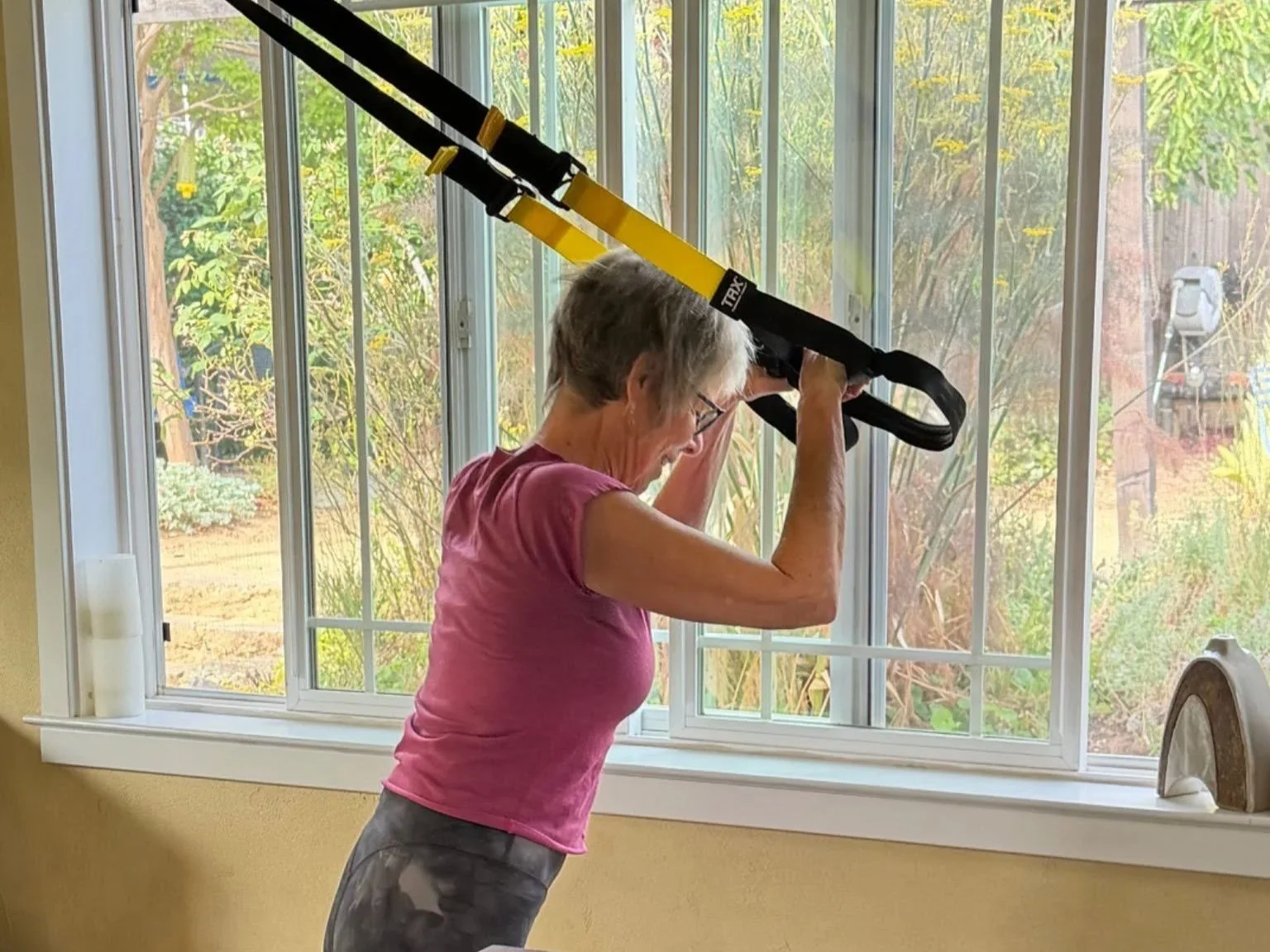
What We Lose, and Why It Matters
Here is the sobering part. After about age 50, we lose muscle mass at a rate of roughly 1–2% a year, but muscle strength declines even faster, somewhere around 3% a year once we're past 60. Strength, it turns out, disappears faster than size does, which is part of why a person can “look” fairly unchanged while quietly becoming much weaker. Zoom out over a lifetime and the numbers are startling: most of us lose something like 3–5% of our total muscle mass per decade after 30, and by the time we've hit our 70s and 80s, that adds up to a real and clinically meaningful loss. The kind that shows up as trouble rising from a chair, climbing stairs, or carrying groceries.
Menopause adds its own penalty on top of ordinary aging. Estrogen isn't just a reproductive hormone, it also supports neuromuscular function and muscle maintenance, and its decline during and after menopause is associated with an accelerated loss of muscle mass, strength, and function in women. This is one reason strength training deserves to be treated as essential medicine for women at midlife.
As for differences between men and women: men generally start out with more total muscle mass, largely thanks to testosterone's effects over a lifetime, and some research suggests men's strength may decline a bit faster in older age. But sarcopenia, the gradual, age-related loss of muscle mass, strength, and function, comes for everyone. Unfortunately, women get an extra push toward it at menopause.
Grip strength has become one of my favorite numbers to talk about, because it is such an elegant proxy for the whole picture. It's cheap to measure (just a handheld dynamometer) and yet it has emerged as one of the more reliable predictors of longevity we have. Large studies, including the PURE study of nearly 140,000 adults across 17 countries, have found that grip strength predicts all-cause mortality, cardiovascular events, and stroke risk. Roughly speaking, every 5-kilogram drop in grip strength is associated with about a 16% higher risk of dying from any cause. That's a remarkable amount of information packed into a squeeze.
What Do Muscles Have to Do With Better Brain Health?
The blood sugar connection. Your skeletal muscles are the biggest sink for the blood glucose floating around your bloodstream after a meal. They're responsible for something like 80–90% of the glucose your body clears after eating. Muscle contraction pulls glucose out of the blood through a pathway that doesn't even require insulin, using a glucose transporter called GLUT4. The more muscle you have, and the more you use it, the more storage capacity you have for all that circulating sugar. Since elevated blood sugar and insulin resistance are now recognized as major, modifiable risk factors for cognitive decline and dementia, this glucose-sink function of muscle is a direct, physiological line from your biceps to your brain.
The myokine connection. Muscle isn't just a metabolic sponge, though, it's an endocrine organ in its own right. When you contract a muscle, it releases a family of signaling proteins called myokines into your bloodstream. Several of these, especially irisin and cathepsin B, are able to cross the blood-brain barrier and act directly on brain tissue, where they're associated with new neuron growth, stronger synaptic connections, and reduced inflammation. Cathepsin B in particular appears to boost the brain's own production of BDNF, often nicknamed “Miracle-Gro for the brain”. Animal studies show it plays a central role in exercise-related memory improvements. In other words, every time you lift something heavy, your muscles are quite literally sending chemical messages to your brain.
Mood and Strength Training
There is something about feeling physically strong that changes something inside for us. A few minutes into a strength training session, I'm ready to sing “I Feel Good”, right along with James Brown. Part of that is chemical: resistance training triggers a release of endorphins, along with dopamine and serotonin, the same “feel-good” trio behind most exercise-mood research. Studies show measurable drops in anxiety, anger, and confusion after just a single session. There's a real psychological lift that comes from feeling your own physical competence and knowing what your body can do.
How Much Strength Training Do You Actually Need?
The current recommendation, which was most recently reaffirmed in the American College of Sports Medicine's 2026 update (its first major update in over 17 years, but I digress), is refreshingly simple:
Exercise all of your major muscle groups for about 1 hour
Train twice a week
Train on non-consecutive days
Do 2–3 sets per muscle group
That's it. The guidelines actually debunk the idea that you need to train to complete muscle failure, or follow some elaborate plan, to get the health benefits. Consistency with a moderate, sustainable program beats a “perfect” plan that gets abandoned, like I have done many times.
And that hour doesn't have to happen all at once. It can come in “snack” form. A few minutes scattered through your day still counts.
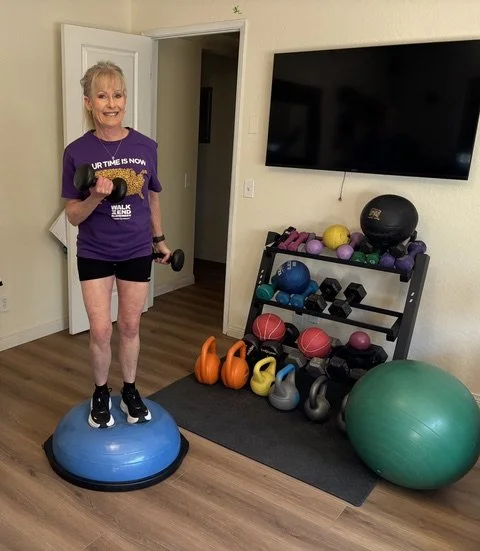
My sister, Shelley, in her exercise studio
How to Get Started
I started by getting help from a personal trainer at our local gym. Then I searched out online videos and followed along. That combination is what helped me actually get going.
I didn't start with two hours a week. I began with short “exercise snacks” of strength training and that evolved over time. Now I have a routine of twice a week.
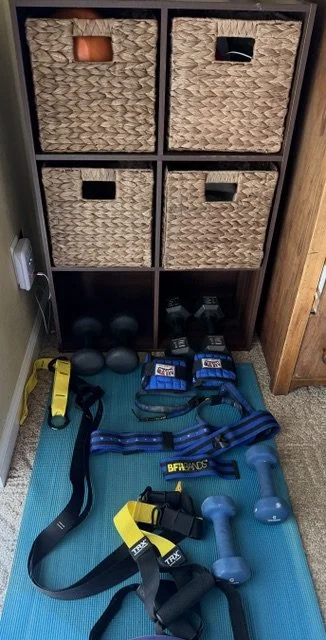
My sister has an entire room devoted to exercise with a set of weights and a big-screen TV. We often put on exercise videos and follow along together for fun. My setup is a little different. It's smaller, simpler, and fits snugly in the corner of my bedroom.
How Do You Measure Muscle Health?
It's more than just how you feel. There are a few ways to test your muscle health:
The chair stand test is free and takes 30 seconds: see how many times you can stand up fully from a seated position without using your hands, or how fast you can do 5 in a row. It's one of the two tests clinical guidelines actually recommend alongside grip strength to flag low muscle strength.
Calf circumference: just wrap a tape measure around the widest part of your calf. Research shows it correlates surprisingly well with muscle mass, with under about 34cm (men) or 33cm (women) as a common flag for low muscle mass.
DEXA scans built for body composition measure much more than bone. They measure lean muscle mass, fat mass, and visceral fat, all broken down in detail. They typically run $100–$400 out of pocket. Or check your local health club. Some offer it for as low as $20.
Bioelectrical impedance analysis (BIA), the kind built into a "smart" bathroom scale, works by sending a faint, painless electrical current through your body and timing how easily it travels. Fat tissue slows the current down, muscle and water let it pass more freely, and the scale uses that difference to estimate a number of health markers. For a rundown of how the technology works and which models perform best in head-to-head testing, see BodySpec's smart scale buying guide.
Grip dynamometers give you that longevity-linked grip strength number in about ten seconds. Here's a roundup of hand grip strengtheners/dynamometers if you want to pick one up.
Your blood sugar can be an indirect signal too. Because muscle absorbs so much of your post-meal glucose, persistently elevated blood sugar can be a clue that your muscle mass, or your muscle's insulin sensitivity, isn't where it needs to be.
Diet and Muscle Health
Protein. You cannot build muscle without protein — that part everyone knows. As a daily target, older adults building or preserving muscle generally do best around 0.5–0.7 grams of protein per pound of body weight. For a 150-pound person, that's roughly 75–105 grams a day, noticeably more than the standard recommended daily amount. However, studies show that there is a ceiling on how much protein your muscles can effectively use in a single sitting. Research on muscle protein synthesis suggests the effective range tops out somewhere around 25–40 grams per meal to fully switch on the muscle-building signal. Protein eaten beyond that amount at one sitting isn't wasted exactly, but it isn't being used for muscle building. The practical takeaway is the same one I've come to live by: don't save all your protein for dinner. Spread it out. Have a real protein-forward breakfast and lunch, not just toast or croissant and coffee. Since most of us fall short of that per-meal threshold, add a snack if you need help reaching your goal.
The leucine trigger. One amino acid does most of the work of flipping the “build muscle” switch: leucine. Older adults appear to need about 2.5–3 grams of leucine at a meal to meaningfully trigger muscle protein synthesis, noticeably more than a younger adult needs for the same effect.
Creatine. This is one I've become more convinced of over time. Creatine supplementation, especially paired with resistance training, has solid evidence behind it for increasing muscle mass, strength, and functional capacity. The brain side of the story is creatine trials suggest modest improvements in memory, processing speed, and executive function. Watch for GI side effects like reflux.
Whey protein. Whey earns its reputation as the gold-standard for muscle-building largely because of its amino acid profile. It's especially rich in leucine and isoleucine, the branched-chain amino acids most directly tied to triggering muscle protein synthesis. Whey is roughly 10–12% leucine by weight, which means about 25 grams of whey protein alone can clear that 2.5-gram leucine threshold. Plant proteins like pea or soy are excellent options too, but fall short on leucine. Research shows that once you fortify a plant protein with extra leucine to match whey's level, it can stimulate muscle protein synthesis just as effectively. So plant-based eaters aren't out of luck; they just need to pay a little more attention to leucine content.
My favorite BFR bands. Blood flow restriction (BFR) training uses bands to gently and temporarily restrict blood flow to a limb while doing light-load exercises. This is one of my favorite tools, and the research backs it up. In older adults, low-load BFR training produces strength and muscle growth that rivals traditional heavy-load resistance training, without needing to lift anything close to maximal weight. That makes it a genuinely useful option for anyone whose joints don't love heavy loading anymore.
Walking after a meal. This simple habit does double duty. A walk of just 10–15 minutes taken soon after eating measurably blunts the blood sugar spike that follows a meal. In some studies, this can cut the glucose spike by 20% or more. This is largely because contracting muscle pulls glucose out of the bloodstream through that same insulin-independent GLUT4 pathway I mentioned earlier. Whether this specific habit also builds muscle mass over time the way structured resistance training does is less clear, but it's certainly training your muscles to do their glucose-clearing job well, meal after meal, which is its own form of muscle health.
The Bone and Muscle Connection
I can't talk about muscle without talking about bone. And this isn't only a women's issue — men get osteoporosis too! DEXA bone scans are recommended for women beginning at perimenopause. I recommend men over 70 get one as well. A majority of postmenopausal women in my BBH program have osteopenia, a precursor for osteoporosis. Several friends have recently fractured wrists or arms, which is a strong predictor of poor bone and muscle health.
Muscle and bone turn out to be in constant conversation with each other. Beyond the obvious mechanical relationship, the two tissues also talk to each other chemically. Muscle releases myokines and bone releases its own signaling molecules called osteokines, and this crosstalk means that losing muscle and losing bone tend to happen together and reinforce one another, a combined condition researchers now call “osteosarcopenia.” It also means that strength training is doing double duty every time you do it: building muscle and sending your bones the loading signal they need to stay strong.
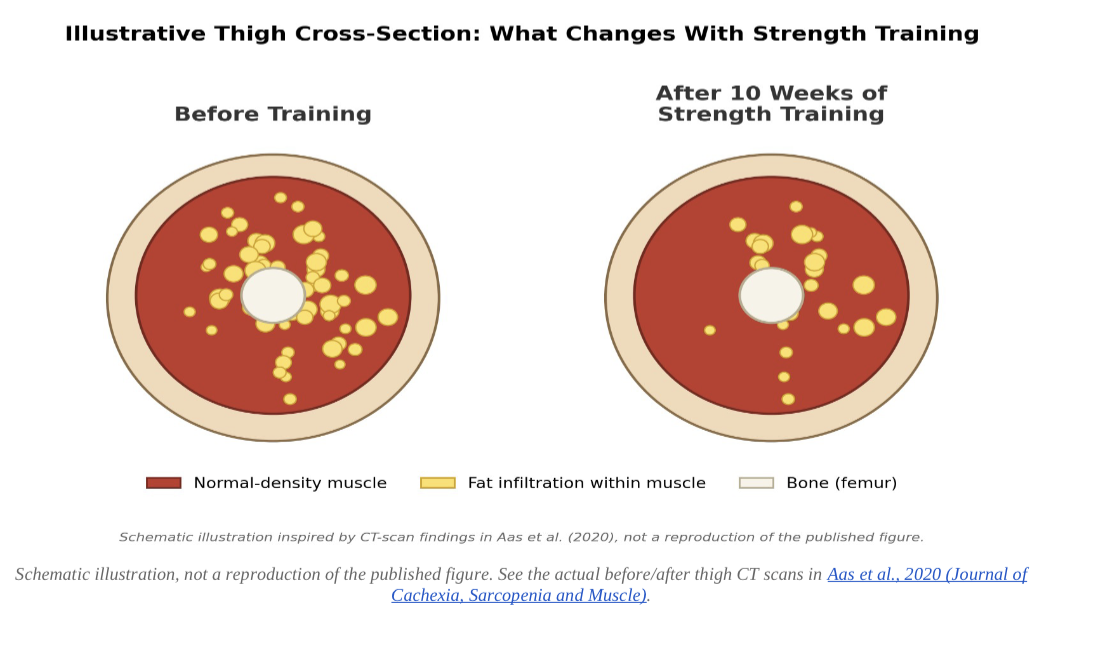
One of the most striking demonstrations of this comes from a study of frail elderly adults, including an 88-year-old man, who underwent CT scans of the thigh before and after heavy-load strength training. After 10 weeks, the gain wasn't just in overall muscle size, it was specifically in normal-density muscle, visible directly on the scan. Strength gains, in fact, tend to outpace visible size gains at this age: in a separate study of men in their 80s, 12 weeks of resistance training produced a 41% increase in strength alongside a much more modest 2.5% increase in measured thigh muscle size; a reminder that “getting stronger” and “getting bigger” aren't quite the same process, especially later in life.
Habits Are Hard to Build
But this is one that is central to our health.
Make it easy.
Make it accessible.
Schedule it for a similar time and day.
Be consistent.
Make it fun. That's why I keep my TRX bands in my bedroom. I plug in my AirPods, tune into my “Empowering Women” music, and I'm actually feeling pretty darn strong.
Strength training doesn't ask for two hours a day, or a room full of equipment, or a body that never gets tired. It asks for 1 hour, twice a week, a little bit of resistance, and the willingness to keep showing up. Everything else: the blood sugar control, the myokines talking to your brain, the bones staying dense, follows from that.
Attention: Brain Body Health is now on Substack. You can download it on your mobile device or computer.
Creating each newsletter takes dedication and passion. Supporting this work ensures it can continue to inspire and educate.
Venmo: @bettyglacy
PayPal: @BettyLacy932
To optimal health and peace for all!

Subscribe to the email list for news and updates on Body-Brain Health
bettylacymd@gmail.com
Brainbodyhealth.org
For more information on Coaching sessions: Contact Dr. Betty @ bettylacymd@gmail.com for an appointment.
Brain & Body Health Newsletter | All content is for educational purposes. Please consult your physician for personal medical advice.
“If you want to go FAST, go alone. If you want to go FAR, go together."
- African proverb
To our optimized health!