March 2026 Newsletter: Play and Focusing your Brain
My mission is to be the first woman in 4 generations to not develop Alzheimer’s Disease (AD). On my journey of discovering ways to mitigate my risk, I pass this information on to you in this Brain-Body-Health (BBH) Newsletter.
Hello, Brain Body Health Citizen Scientists
You know that moment...
This just happened to me! While talking to a friend on my cellphone, she asked me for some information that sent me looking for my phone! Maybe you've had this happen to you?
Or, you get a quick message and somehow resurface 20+ minutes later, having learned something fascinating about Megan and Harry, or the crazy new gelatin diet. I hear versions of this from clients all the time, usually followed by: “Is something wrong with my brain?” Short answer: no. More accurate answer:
Your brain is adapting to stress, to stimulation, and to how it’s being used
And here’s the part most people don’t expect: It may also be missing something essential... like PLAY!
There’s a quote often attributed to George Bernard Shaw:
“We don’t stop playing because we grow old; we grow old because we stop playing.”
It sounds light, maybe even a little nostalgic. But neurologically, it’s surprisingly accurate.
Because somewhere along the way, many of us traded curiosity and humor for constant productivity. And while that might look efficient on the outside, the brain experiences it very differently.
That’s not random. It’s your brain changing.
The Brain at Play:
Play is biologically necessary for humans. Yes, I said necessary because of its benefits of stress reduction, boosting creativity, and strengthening relationships. And we forget about its importance. When is the last time your doctor or therapist asked you about how much you play? What if we really valued play? I’m imagining your health care provider saying, “And what is your history of play Mr. Smith? And the last time you had a belly laugh? Or what have been the most playful times in your life?
Play equals brain health. Take our SLEDSSSS acronym. Play checks all the boxes. It impacts sleep, learning, exercise, diet, socialization, stress reductions, sensory health, and spirituality/purpose. Engaging in, "unserious" activities—like games, sports, or silly, unstructured fun—triggers endorphins, enhances cognitive flexibility, and reduces over-seriousness. Haha. It is essential for our brains, bodies and spirits. fostering resilience, joy, and social connection.
What’s better than sharing a good belly laugh with friends?
All this sounds good, But honestly I had my doubts about going to our local senior play dates. Then I decided to pull out my fairy godmother costume and felt called into action, where I assisted in making wishes come true to the crowd very happy people. The games, music, and belly laughs were unexpectedly joyful. My favorite activities were scarf dancing, translating gobble-di-gouk, and introducing stuffed animals. I came away committed to the Senior play dates. I’m a convert. I even invited teacher/play coach Jim Beatty, known to our community as the Dancing Grandpa, to my recent brain health talk. We sang "row row row your brain" in rounds, which was a lot of fun. There was more laughter in the room than I’ve ever had before. Check out Play resources in your area. Many are available at senior centers, YMCA’s, YWCA’s, and recreation centers.
Social Media is not PLAY
Our brains they are a-changing. As we age, the prefrontal cortex—the part responsible for focus, planning, and decision-making— doesn’t disappear, but it does become a bit less efficient. At the same time, levels of dopamine shift, which affect motivation and the ability to stay engaged with tasks that aren’t immediately rewarding. That’s why social media is so alluring and dangerous. It provides short, rewarding bursts of dopamine, similar to eating candy or gambling. Add in a modern environment that constantly pulls your attention in ten different directions, and it’s no surprise that focus starts to feel harder. Lots has been written about the effect of social media on the brain and it is not a pretty picture. I devoted a Newsletter to attention span.
The Emotional Brain & the Amygdala Hijack
There is another layer that often gets overlooked. Your emotional brain. The amygdala is always scanning for threat, not just danger, but pressure, overwhelm, and that subtle feeling of “too much.” When it senses those signals, it can take over in what’s often called an amygdala hijack.
And when that happens, your thinking brain, the prefrontal cortex, basically gets benched.
So instead of calmly finishing what you started, your brain says: “Let’s check something. Let’s switch tasks. Let’s do literally anything that feels easier right now.” That’s not a discipline problem. That’s a brain state.
This aligns closely with what we see in neuroscience research on stress and attention. When the brain feels overwhelmed, it shifts into survival mode and focus becomes collateral damage.
The Morning Brain: Why Your First Hour Matters
Now, let’s add one more piece that I talk about a lot with clients: your morning.
The first 30–60 minutes after you wake up are essentially your brain’s “startup sequence.” You’re transitioning from slower sleep-related brain activity into more alert, focused states. If the very first thing you do is grab your phone, scroll, check email, or dive into input, you’re interrupting that natural transition.
Translation: your brain doesn’t get a chance to stabilize before the world starts pulling on it. And then we wonder why focus feels scattered by 10 a.m.
Your Brain Care Plan (Simple, Not Easy)
This is where your Brain Care Plan comes in. Not as another thing to do, but as a way to support how your brain actually functions.
Here’s what I encourage clients to focus on:
Protect your morning. Give your brain a little space to wake up before handing it over to notifications, headlines, and everyone else’s priorities. Even a few minutes makes a difference.
Build one true focus block. Not multitasking. Not switching. Just one uninterrupted stretch of attention. This is how you rebuild your brain’s ability to stay with something.
Notice the drift. Learn to catch when your attention shifts, especially when it’s driven by stress or overwhelm. That moment of awareness, your superpower, is how you shift control back to your headquarters, the thinking brain.
Bring play back in. This is the one most people skip. Not as a reward. Not as something extra. As part of how you function.

Play increases dopamine naturally. It reduces stress. It improves flexibility in thinking. It helps your brain move out of rigid, reactive patterns and into a more adaptable state.
Why Play Is Not Optional
A brain that never plays becomes a brain that struggles to focus. A brain that is constantly stressed becomes a brain that defaults to distraction. But a brain that is supported through structure, recovery, and yes, a little bit of play, becomes more steady, clearer, happier, and far more resilient.
Final Thoughts
So if you’ve been feeling a little more scattered lately, a little less focused, a little more pulled in every direction, it may not be that your brain is failing you. It may just be asking for a different kind of support. And possibly... a little more play.
If you try one thing this week, make it this: Protect your morning and notice where you can add even a small moment of play. Your brain will do more with that than you think ;)))
Associative Memory: Why Your Brain Makes More Connections (and More Detours)
There’s one more piece that often surprises people—and it’s actually a strength, not just a challenge.
As the brain ages, associative memory—the ability to link ideas, experiences, and concepts—often becomes richer. Your brain has built decades of stored information, and the hippocampus works to connect new input with past experiences.
That’s why you might notice this pattern: You start thinking about one thing... and it quickly connects to three others. This happens because your brain is more interconnected, not less.
From a neuroscience perspective: There is broader activation across memory networks. The brain relies more on accumulated knowledge (sometimes called “crystallized intelligence”). There is less tight filtering from the prefrontal cortex, allowing more associations to surface.
The upside: greater creativity, deeper insight, stronger pattern recognition
The challenge: more mental “branching” easier distraction, losing the original thread of thought
In other words, your brain is not just forgetting—it’s linking more than it used to.
This is where your Brain Care Plan becomes even more important.
Focus helps you stay on the main path.
Awareness helps you notice when you’ve wandered.
Play supports this system by encouraging flexible, not chaotic, thinking.
So when you find yourself thinking, “What am I looking for?” It may not be a failure.
It may be your brain doing exactly what it’s designed to do: connect, associate, and explore. The goal isn’t to shut that down. It’s to guide it.
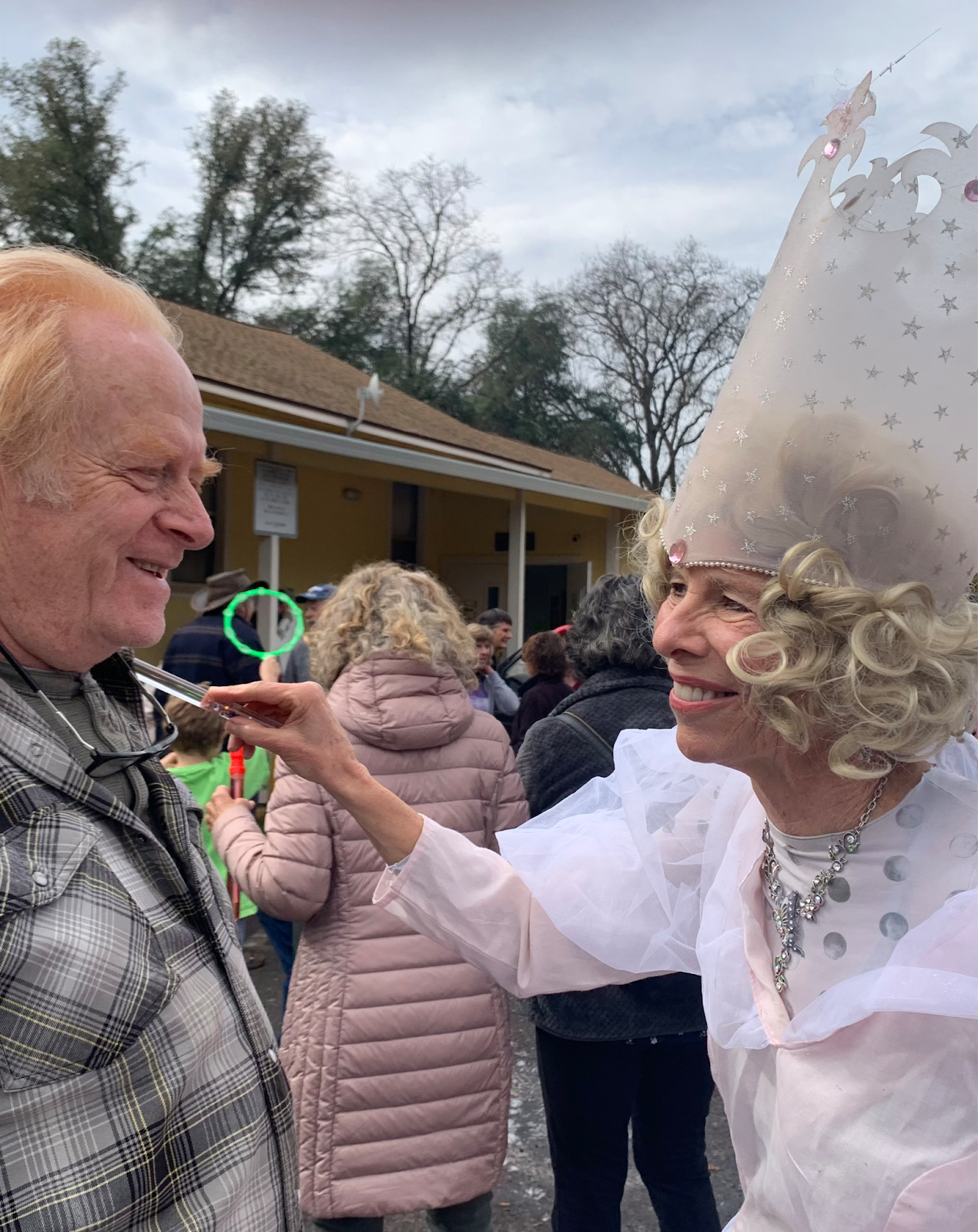
Your Fairy Godmother at play, bestowing wishes:
To find out more about Senior Play Dates, contact Jim Beatty, the Dancing Grandpa at: timefly@aol.com.
These very fun senior play dates were inspired by Mas Amore aka Karen Rosen.
Resources:
Laughter and Brain Health:
https://www.independent.co.uk/bulletin/lifestyle/laughter-health-benefits-research-belly-laugh-b2888657.html
Fluid versus Crystallized Intelligence:
https://www.simplypsychology.org/fluid-crystallized-intelligence
Dopamine Detox: Pros and Cons;
https://thriveworks.com/help-with/self-care/dopamine-detox/#:~:text=What Is a Dopamine Detox, like reading or being outside
Attention: Brain Body Health is now on Substack. You can download it on your mobile device or computer.
Creating each newsletter takes dedication and passion. Supporting this work ensures it can continue to inspire and educate.
Venmo: @bettyglacy
PayPal: @BettyLacy932
To optimal health and peace for all!

Subscribe to the email list for news and updates on Body-Brain Health
“If you want to go FAST, go alone. If you want to go FAR, go together."
- African proverb
To our optimized health!