My mission is to be the first woman in 4 generations to not develop Alzheimer’s Disease (AD). On my journey of discovering ways to mitigate my risk, I pass this information on to you in this Brain-Body-Health (BBH) Newsletter.
Hello, Brain Body Health Citizen Scientists
Trick or Treat: What Sugar Does to Your Brain, Heart, and Cells
The scariest thing in my office this October isn't a costume. It's a lab value. A few of my clients have hemoglobin A1c numbers creeping upward, quietly, the way the best horror movies build suspense. Nobody has crossed into diabetes. But the trend line is the plot, and I'd like to rewrite the ending.
As a kid, my dad would take us on Sundays to Baskin-Robbins ice cream shop around the corner from our house. Every October I looked forward to their addition of the dark grey, glossy licorice flavored delight, my favorite! Growing up, I had a colossal sweet tooth that has never really left me. In college, I lived on chocolate covered donuts for breakfast and pizza every night for dinner. Like Maya Angelou said, and Oprah loves to repeat: If we had known better, we would have done better. Chocolate is still my frenemy. I have no off switch. I can't keep it in our house. It is just too addicting for me.
There are endless tools to curb our sweet tooth and lower our blood sugar: diets, glucose monitors, apps, supplements, hacks. Some are useful. Like putting chocolate in the freezer, haha. But after years of watching what actually changes people's numbers, I keep landing on the same unglamorous answer: Consistent daily habits matter more than any single tool. Gone are the days of donuts, pizza and ice cream every weekend. Occasionally? Sure. That's the difference between a treat and a lifestyle.
In case you missed it:
we’ve been exploring our precious brain and real-life superpowers:
July: Your Super-Duper power of Exercise
August: The Superpower of Strength Training
September: The Superpower to Rewire
What your A1c knows about your brain
Your A1c is a blood test that shows your average blood sugar over the past three months. Think of it as a sugar diary you can't erase. That's why it rewards habits: it reflects what you do most days, not what you did on October 31st.
So what do the numbers mean? Standard lab ranges are broad. "Prediabetes" alone stretches from an A1c of 5.7 all the way to 6.4. In brain health, we aim for narrower, tighter targets. And we take pre-diabetes seriously!
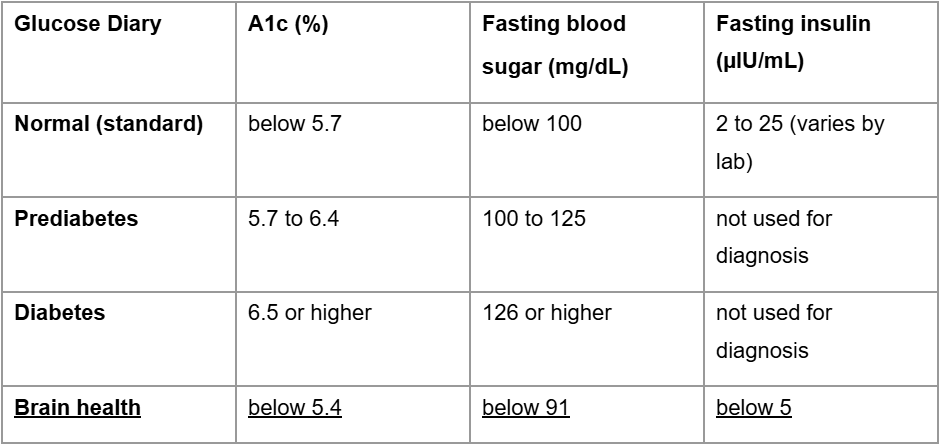
The fasting blood sugar cutoffs have stayed the same for years. In my opinion, these ranges should be narrower and take age into account. One caution: if you take medication that lowers blood sugar, talk with your doctor about the right target for you, because aiming too low can cause dangerous hypoglycemia.
Your brain reads the A1C diary too. People whose blood sugar runs high over the years are more likely to develop dementia, even if they never develop diabetes. Higher blood sugar has also been linked to weaker memory and a smaller hippocampus, the brain's memory center and one of the first areas Alzheimer's affects.
Some scientists even call Alzheimer's "type 3 diabetes." The idea is that brain cells can stop listening to insulin, much like muscle and liver cells do in type 2 diabetes. When that happens, they struggle to use sugar for fuel and become easier to damage. It isn't an official diagnosis, and Alzheimer's is about more than sugar. But the message is real: your blood sugar and your brain's health are closely tied.
Here's the hopeful part: sugar isn't the brain's only fuel. When we eat very few carbohydrates, or go long enough without eating, the liver turns fat into ketones. This state is called nutritional ketosis. Ketones are a backup fuel the brain can burn, and they don't need insulin to get into brain cells. Brain scans show that in early Alzheimer's, the brain's ability to use sugar drops, but its ability to use ketones stays largely intact. Think of it as a second power line into a house when the first one is failing.
A ketogenic diet isn't right for everyone, and anyone on insulin or other blood sugar medications should talk with their doctor first. But even a longer overnight fast nudges the body gently in that direction.
Sugar and your arteries: the broken glass effect
Boston Heart Diagnostics has a memorable way of picturing this: high blood sugar turns the inside of your arteries into something like broken glass. A healthy artery lining is smooth, flexible, and slippery, and blood glides right along it.
When sugar stays high, it sticks to the artery wall and makes it stiff and rough, full of tiny nicks and scrapes. Cholesterol gets caught in those rough spots, the body sends in its repair crew, and the area becomes inflamed. Over time a bump of plaque builds up, and the stiff wall can no longer stretch with each heartbeat.
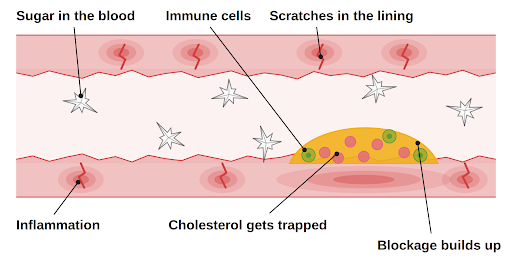
Your brain depends on those same vessels. Damage to small arteries is a major driver of vascular dementia and often travels alongside Alzheimer's. What's good for the heart is good for the brain.
Insulin, inflammation, and cancer
Siddhartha Mukherjee, the cancer doctor who won a Pulitzer Prize for his book The Emperor of All Maladies, has been looking at how blood sugar and insulin affect cancer.
Insulin is the hormone that moves sugar out of your blood and into your cells. It also tells cells to grow. Mukherjee's team found something surprising in mice. Certain cancer drugs raised blood sugar. The body responded by releasing extra insulin, and that insulin helped the cancer cells resist the drug. But when the mice ate a very low-carb diet, their insulin stayed low, and the drugs worked much better.
One important caution: this was done in mice, and the diet on its own was not a cure. The lesson isn't "eat keto to beat cancer." It's that constantly high insulin acts like fertilizer, and cancer cells can take advantage of it.
Inflammation is the thread connecting these three stories. Persistently high glucose and insulin feed a low-grade, body-wide inflammation that damages arteries, stresses the brain, and creates a friendlier environment for abnormal cells.
Start your breakfast with a savory meal
Breakfast is the first decision of the day, and it sets the tone for the rest.
Giving yourself a fasting period before eating improves glucose levels. That’s why it is called break-fast! Duh. Close the kitchen by 7pm and make your first meal 12 hours later. Most people are comfortable with a 12-14 hour fast before their first meal.
When researchers at Stanford had healthy people wear glucose monitors, a simple bowl of cornflakes and milk sent most of them into a big blood sugar spike, high enough to look like prediabetes. The classic "healthy" breakfast turned out to be a roller coaster.
What goes up must come down. A sugary start brings a spike, then a crash, and that crash shows up as mid-morning hunger, tiredness, brain fog, and craving more sugar. Starting with a fast and a savory breakfast with some protein smooths out the ride. People who eat a protein-rich breakfast tend to snack less later in the day, and a steady breakfast even helps your body handle lunch better.
One easy trick: eat your vegetables and protein first, and save the bread, rice, or potatoes for last. Same meal, smaller spike.
Savory breakfast ideas:
My go-to breakfast: two poached eggs, a buckwheat cracker, and yogurt (Plain 2%fat 17gms protein) with chia seeds, and/or walnuts, hemp seeds.
Avocado on a seed cracker: mashed avocado, a sprinkle of hemp seeds, and a soft-boiled egg.
Smoked salmon plate: salmon, sliced cucumber and tomato, a spoonful of cream cheese or labneh, and capers.
Savory cottage cheese bowl: cottage cheese topped with cherry tomatoes, cucumber, olive oil, black pepper, and everything-bagel seasoning.
Veggie scramble: spinach, mushrooms, and onion sautéed in olive oil, scrambled with two eggs and a little feta.
Leftovers: last night's roasted vegetables and chicken, warmed up with an egg on top.
Stevia and the stubborn sweet tooth
I'm a big stevia fan, so I wanted to know: does a sweetener keep the sweet tooth alive? A large study suggests not. People who ate more sweet foods for six months didn't come to crave sweets more, and people who ate fewer didn't lose their taste for them. Our sweet tooth is stubborn, so real change comes from habits, not from retraining our taste buds.
One tip: read the label. Many stevia products are mixed with erythritol, a sugar alcohol that may make blood more likely to clot. Look for pure stevia.
My take: a sweetener is a bridge, not a destination. The real goal is a life that doesn't need everything to be sweet.
And what about wine?
Here in wine country, this question comes up a lot. A glass of dry wine has only about a gram of sugar, so it barely moves blood sugar. But the old idea that "a glass a day is good for you" hasn't held up. Earlier studies counted people who had quit drinking because they were already sick as "non-drinkers," which made moderate drinkers look healthier than they were.
Newer research tells a different story. A large British study found that brain volume began to shrink at just one to two drinks a day. Alcohol also disrupts deep sleep, when the brain does its nightly cleanup. And in 2025, the U.S. Surgeon General warned that alcohol raises the risk of several cancers, including breast cancer. As we age, the same glass hits harder, because our bodies process alcohol more slowly. And remember, alcohol affects women differently. After menopause, women have less body water. That's why the guidelines set lower limits for women and why breast cancer risk starts to rise even with light drinking.
Alcohol also lowers our guard. After a glass or two, the cheese plate or the Halloween candy bowl suddenly looks like a very good idea.
When it comes to your brain, less is better, and none is best. If you do drink, make it a rare exception rather than a nightly ritual, and notice how it affects your sleep. Non-alcoholic wines have come a long way, and sparkling water with a twist of citrus can become a pleasant evening ritual of its own.
Habits over heroics
Here's the good news for Halloween. Research on habits shows that a new habit takes about two months to become automatic, though it varies a lot from person to person. Even better, missing a day here and there doesn't undo your progress.
One night of candy won't undo your habits. The candy bowl still on the counter on November 15th might. A few simple rules:
Never miss twice. One off day is a blip. Two starts a new pattern.
Anchor the morning. Start with a savory breakfast. It makes every other choice easier.
Move after every meal. Even a 10-minute walk helps your muscles soak up sugar.
Take exercise snacks. A few minutes of stairs, squats, or a brisk walk, sprinkled through the day.
Hand out nuts instead of candy. Packaged nuts, or nuts and fruit, make a good Halloween treat. Costco has a good selection. Read labels for lower sugar options.
Pair treats with protein or fat. A handful of nuts or a spoonful of cottage cheese slows the sugar rush.
Go easy on fruit smoothies. A blender makes it easy to drink several servings of fruit in a few minutes, and blood sugar spikes. Fruit isn't the problem; it's how much and how fast. Liquids don't fill you up like real food.
A Smarter Smoothie
Add protein and fat: plain Greek yogurt, nut butter, chia, or flax.
Avoid banana, mango, honey
Toss in spinach or kale.
Blend with water or unsweetened almond milk, not juice.
Keep it to one cup.
The sweetest habit
Brain, heart, and cells are all reading the same sugar diary. You don't have to be perfect to change what it says. You just have to be consistent. Enjoy a piece of Halloween chocolate this year, then let your good habits carry you through to November.
Happy Halloween!
Attention: Brain Body Health is now on Substack. You can download it on your mobile device or computer.
Creating each newsletter takes dedication and passion. Supporting this work ensures it can continue to inspire and educate.
Venmo: @bettyglacy
PayPal: @BettyLacy932
To optimal health and peace for all!

Subscribe to the email list for news and updates on Body-Brain Health
bettylacymd@gmail.com
Brainbodyhealth.org
For more information on Coaching sessions: Contact Dr. Betty @ bettylacymd@gmail.com for an appointment.
Brain & Body Health Newsletter | All content is for educational purposes. Please consult your physician for personal medical advice.
“If you want to go FAST, go alone. If you want to go FAR, go together."
- African proverb
To our optimized health!